Happy Trails

I was a relatively early adopter of social media—Facebook (2007), Twitter, (2009), and Instagram (2011). I wanted to be a proficient user before my children. I was, but that wasn’t sufficient. It turns out the young men and middle-aged men are not the same—particularly, when the old guy grew up in an analog world and developed analog virtues that are foreign to digital natives. I’ve been able to help my boys and other young people understand and mitigate some risks and endure a lot of disappointments of online life. But I’ve come to the conclusion that I can do that without further participation in two platforms. So, I’m letting my friends/acquaintances know that I’ll be deleting Facebook and Instagram this month, though I’ll continue on Twitter for now.

One factor has to do with my use of the platforms themselves. Since Twitter still allows a feed that is not algorithmically generated and I can easily control what I see there (I get notifications only from those whom I follow, and I can block and mute easily), I am able to use that platform as a news aggregator. (I’ve never really considered leaving Twitter, because I don’t use it in a way that amplifies its downsides). The algorithmically-governed Facebook and Instagram, by contrast, make it more difficult for me to see the range of things I want to see on those platforms.

The greater issue, though, is these digital environments themselves. In short, they are too context deficient to serve friendship. (This is not really a problem for my news-focused use of Twitter). Facebook and Instagram give us many impressions of our friends and acquaintances, but these impressions cannot replace a hug, or a smile, or a conversation over a meal. And often, without the context of time together, the impressions we get are skewed or simply false. So, I’m leaving Facebook and Instagram, in the end, because I don’t want just to know about my friends. I want to know my friends in truth. And the former is getting in the way of the latter.

I’m still figuring out what I might do instead. Some people I respect have their own websites, blogs, micro-blogs, etc. I have a website that I’ve started posting bits from reading to—the sort of thing I’ve used Facebook for the most over the last few years. I might add a micro-blog to post pictures. I’ve never been the best blogger, but I’m hoping to write more both formally and informally in the years to come. We’ll see how that goes. In any case, I trust that my friends know how and where to find me in real life. In the meantime, happy trails.

P.S. If you want more context for all this, I began seriously thinking about taking this step over the course of research for some lectures I gave on digitally mediated relationships a little over a year ago. See those here: https://resources.covenantseminary.edu/programs/the-changing-self-and-the-challenge-of-ministry
Trollope on Reform in the Age of Mass Media

“In former times great objects were attained by great work. When evils were to be reformed, reformers set about their heavy task with grave decorum and laborious argument. An age was occupied in proving a grievance, and philosophical researches were printed in folio pages, which it took a life to write, and an eternity to read. We get on now with a lighter step, and quicker. ‘Ridiculum acri Fortius et melius magnas plerumque secat res.’ Ridicule is found to be more convincing than argument, imaginary agonies touch more than true sorrows, and monthly novels convince, when learned quartos fail to do so. If the world is to be set right, the work will be done by shilling numbers.”

Anthony Trollope, The Warden, Oxford World’s Classics (Oxford: OUP, 2014), 124.

The Warden, Anthony Trollope

‘Indeed, I like Mr Bold much, personally,’ continued the disinterested victim; ‘and to tell you the “truth,”‘–he hesitated as he brought out the dreadful tidings, –‘I have sometimes thought it not improbable that he would be my second son-in-law.’ The bishop did not whistle. We believe they lose the power of doing so on being consecrated; and that in these days one might as easily meet a corrupt judge as a whistling bishop; but he looked as though he would have done so, but for his apron.’

Happy Christmas from the Middle East

I will never forget the day in Baghdad when we had some visitors. They had come to see what it was really like for Christians in Iraq. They were so surprised by how happy the thousands of people were in our congregation. “How can you be so happy when you are surrounded by suicide bombs, mortar rockets and such violence?” One of our young people answered the statement. “You see when you have lost everything, Jesus is all you have got left.

All you have got left is the love of that refugee child. That to us in the Middle East is all that matters this Christmas. The terrorism has got so bad in Iraq that I have had to leave. So I have moved to the other place where I work, Bethlehem. That little town where Jesus first came. Two-thousand years after he first came, he is still everything to the people. He is still everything to our Christians in Iraq and he can still be everything to us. You see when Christmas is over, when you have had all your presents and food, Jesus is all we have got left.

Canon Andrew White, “Happy Christmas from the Middle East” (via writing in the dust)

Quote

The point here …

The point here is not to suggest that the NRA and its allies are a threat to American democracy itself. Rather, it’s that they’re a threat to the quality of our democracy. Democratic theorists tend to see open, rational public deliberation as a key element of a successful democratic order: it helps citizens make honest and informed choices about which policies and politicians are worth supporting, about which values they want to shape the system that’s supposed to represent them. The move to cast every gun regulation as a threat to the Second Amendment is opposed to that democratic debate. It’s a stalking horse for the specter of tyranny, a fantastical conversation-ender rather than a point of view worth taking seriously.

Worth reading:  http://www.theamericanconservative.com/articles/rethinking-the-right-to-bear-arms/ (via @ayjay)

Routine

I read the excerpt below from Karl Ove Knausgaard’s book “My Struggle” in a review of it by James Wood (who happens to be from Durham) in the New Yorker.  These days, I can relate.  There is so much I want to do that it is a struggle not to see the routine of everyday life, especially with my kids, as an obstacle.  I never understood why people would tell me, “Don’t work too much when the kids are little, because you’ll never get the time back…it goes so fast.”  I never wanted to work more when my wife was responsible for most of daily routine for the kids.  Now, it is a constant temptation.

Inside, it is a question of getting through the morning, the three hours of diapers that have to be changed, clothes that have to be put on, breakfast that has to be served, faces that have to be washed, hair that has to be combed and pinned up, teeth that have to be brushed, squabbles that have to be nipped in the bud, slaps that have to be averted, rompers and boots that have to be wriggled into, before I, with the collapsible double stroller in one hand and nudging the two small girls forward with the other, step into the elevator, which as often as not resounds to the noise of shoving and shouting on its descent, and into the hall where I ease them into the stroller, put on their hats and mittens and emerge onto the street already crowded with people heading for work and deliver them to the nursery ten minutes later, whereupon I have the next five hours for writing until the mandatory routines for the children resume.

Read more: http://www.newyorker.com/arts/critics/books/2012/08/13/120813crbo_books_wood#ixzz2GKo6eozg

Then Bishop H.C.G. Moule Remembers J.B. Lightfoot

I came first into his presence when in June i860 1 called on him at his rooms the rooms which had been Isaac Newton’s, nearly two centuries before and asked to be entered on his list of freshmen. Desperately shy was I.  And he, if I do not mistake, felt a little shy too, for it was his nature so to be. But though a Cambridge Tutor certainly in those days could not possibly be intimate with all his pupils, he exercised from the very first a very powerful influence on me by the magnetism of the good greatness of his personality, and the truehearted kindness which looked always through his reserve. All through those years, he was laying the deep foundations of his vast theological knowledge, chiefly in the vacations, and (during term time) by night. No man ever loitered so late in the Great Court that he did not see Lightfoot’s lamp burning in his study window, though no man either was so regularly present in morning Chapel at seven o’clock that he did not find Lightfoot always there with him.
 
From George R. Eden and F.C. Macdonald (eds.), Lightfoot of Durham:  Memories and Appreciations (Cambridge:  Cambridge University Press, 1933), 5.

Bede’s World and Beowulf Redux, A Guest Post by Dr. Walker Cosgrove

Was it ok for Charlie’s class to do a reenactment of Beowulf at Bede’s World, or was it anachronistic?  My good friend and Medievalist, Dr. Walker Cosgrove, answered the question for me and kindly gave me permission to post his response for the edification of all.  See below:

“First, the only manuscript that we have of Beowulf is from around 1000.  So your museum curator is only partially correct.  The manuscript is not from the 11th century, but rather from around the turn of the 11th century.  This means that the manuscript comes from Anglo-Saxon England, not post-Norman invasion (1066).  While the Anglo-Saxon world of 1000 was much more stable, centralized, and Christian that that of 600, it is culturally more closely related to 600 than post-1066.  The 11th century experienced much change, development, and growth, and so to equate early-11th with the late-11th century would be like comparing the early-20th with the late-20th century.
Second, just because the manuscript is from the turn of the 11th century does not mean the world it relates to us is from that period.  The world of Beowulf, with exception of some forced Christian ideas inserted (probably) from the monk copying the manuscript, is very much the world of Bede.  There is no scholarly consensus of when the poem was composed, dates ranging from around 650 to 1000.  Most scholarship early in the 20th century supposes an early composition; however, post-1980 scholarship is more cautious about the dating.  Regardless of the exact date of composition, it still portrays well the world of Anglo-Saxon England circa 600 (or the world of pre-Viking norse, or the further side of the Rhine).  Even if there is no oral/written version Beowulf before, say, 1000 (which I highly doubt), I would still say that Bede would have recognized the world therein, and that it was completely appropriate to have Charlie in a “play” about Beowulf while visiting the sites of Bede.Finally, the world of Beowulf is actually not England proper, but rather Scandinavia, with Beowulf from among the various Germanic tribes from modern-day Sweden and Heorot from modern-day Denmark.  And the world that Beowulf portrays for pre-Viking Scandinavia circa 600 is accurate, and we can even cull some historical information from the text like several of the princely and noble families named and listed who were pre-Viking norse families.  Even so, it is a piece of epic literature, and thus not simply a “historical” source; however, the world it imagines is very much accurate, with its heavy emphasis on:

  • Fate and pagan (and in the poem sometimes the Christian God is merely a substitute for fate, the two terms being often interchangeable)
  • Evil (Grendel, Grendel’s mom, and the dragon) as something external to the individual and the community, which has to be defeated (as oppose to evil inherent in humanity, like sin)
  • A society built on heroism, honor, and vengeance (One of the best descriptions of the Germanic warrior code comes from Beowulf, see: “Beowulf, son of Ecgtheow, spoke: / ‘Wise sir, do not grieve.  It is always better / to avenge dear ones than to indulge in mourning. / For every one of us living in this world / means waiting for our end.  Let whoever can / win glory before death.  When a warrior is gone, / that will be his best and only bulwark … Bear up / and be the man I expect you to be.'” 1383-1389, 1395-1396)
  • The importance of the warrior troop (even though Beowulf does most of the fighting, he does not do it without his troop.  Compare this with, say Sir Gawain and the Green Knight or some other Arthurian tale where the characters are often waging their battles alone, and often their battles revolve around virtue and vice), celebrating in the mead hall with one’s troop, and the gift giving to those loyal to you.

Thus Beowulf represents well an early-medieval Germanic culture, regardless of geographical location–Scandinavia, across the Rhine, or even Anglo-Saxon England.”

Bede’s World

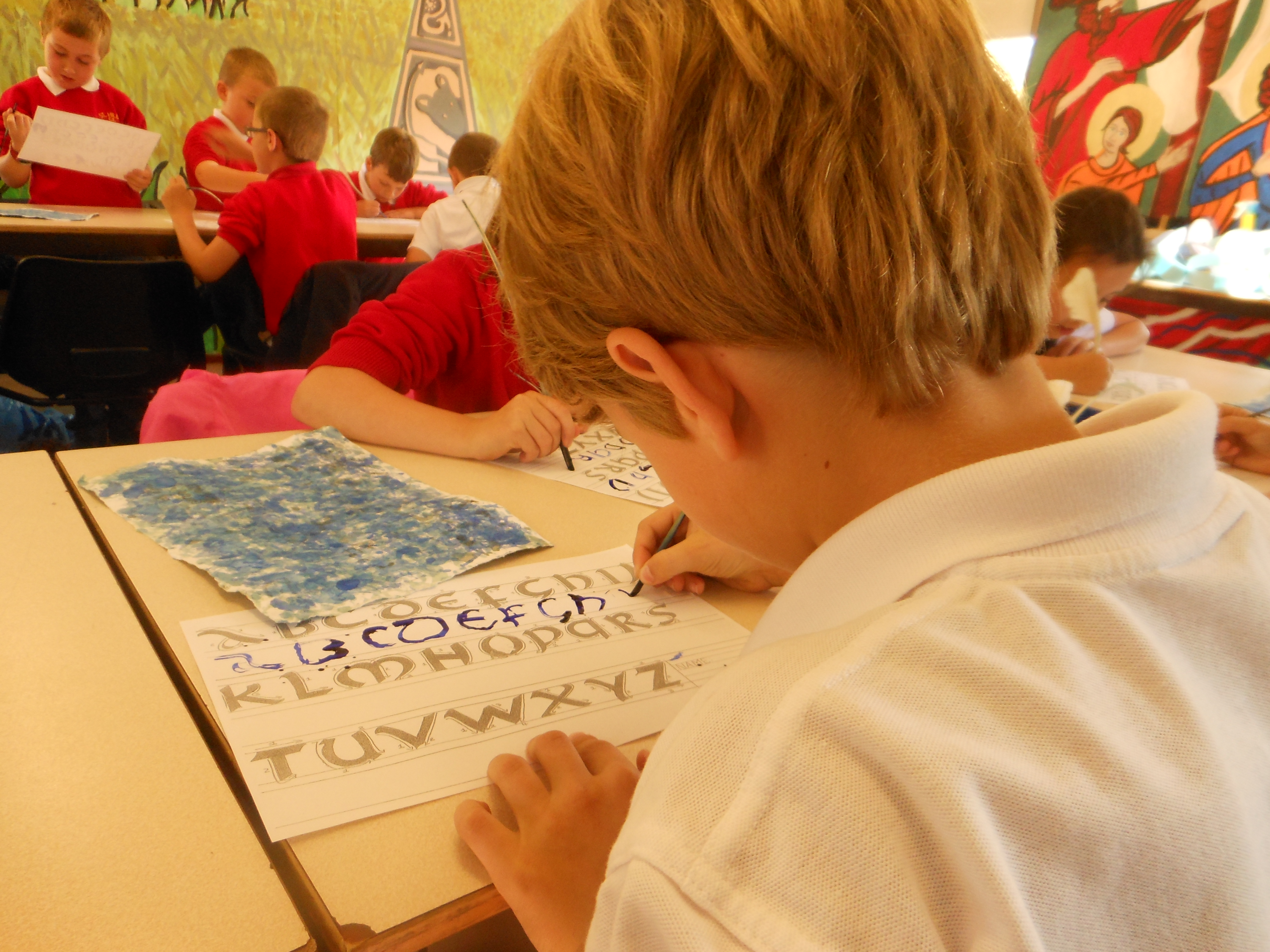
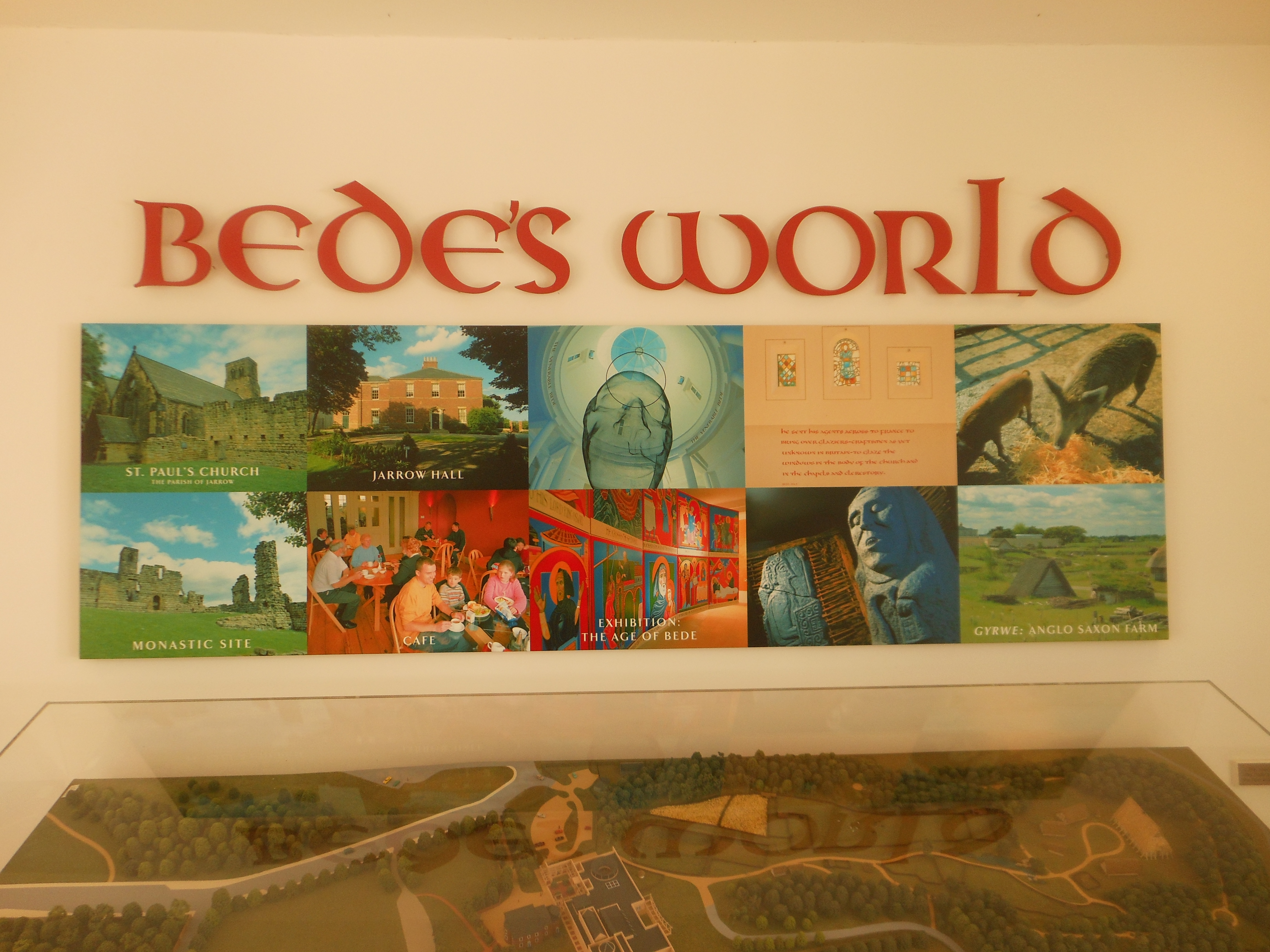
The Venerable St Bede is an important figure in Christian history, in general, and British history, in particular (see the BBC’s brief biographical sketch:  http://www.bbc.co.uk/history/historic_figures/bede_st.shtml).  So, I was excited to accompany Charlie on a trip to Bede’s World in Jarrow, a place dedicated to introducing St Bede, his thought, and his world.  Charlie’s class has been doing a literacy unit on Beowulf, and a short rehearsal and reenactment of the story was a part of the program.  One of the assistants to the main staff person responsible for our group engaged me in a conversation regarding the dating of Beowulf, arguing that the earliest version is from the eleventh century.  This, of course, would make a comparison of Beowulf with the time of Bede anachronistic.  Leave it to me get into this sort of conversation and become conflicted about the premise of the whole trip.  I’ll have to contact my buddy, medievalist Walker Cosgrove, about this to set my mind at ease.  At any rate, we had a great time, and I found the presentation of Bede and his world at this museum very well done.  In my limited experience, the English certainly know how to do museums!  See below for a few pictures from our trip.

Discussion of eighth century uncial copy of the Bible called “Codex Amiatinus”

Practicing our uncials

Reenacting Beowulf

Update: the Unstable Nature of Social Time (or Moving to a Different Country is Weird)

I’m not sure what that title means.  It is inspired by some of the titles I’ve seen for academic publications and conference papers in Biblical Studies and the Humanities.  The paradox of technical jargon is that, while it is meant to clarify, it often obscures.  So, I’ll be clear:  we’ve only been in the UK for 19 days, but August 31st seems like a lifetime ago.

JE and the boys have been great.  Our transition has gone incredibly smoothly.  Life is good, which provides a partial reason for the lack of blogging.  All the same, I’ve been the detail guy for our family and have little time or energy to blog or write (or study, for that matter!).  I hope to do better as we establish a regular schedule.  In the meantime, I thought I’d walk you, dear reader, through our transition with a few representative images and reflections.

Image

Our trip had a very happy beginning.  We arrived at Lambert in plenty of time, got our bags sorted, and made a leisurely stroll onto the airplane.  Last summer, when I told Charlie that Jane-Ellis and I were going to England to visit PhD programs, he was disappointed that he wasn’t allowed to go, mostly because he wanted to fly.  We took three flights–Saint Louis to Dallas, Dallas to London, and London to Newcastle–and the boys loved it.  Aside from being the last five people onto the plane in Dallas, the transatlantic flight being strangely hot, and almost missing our connection to Newcastle, everything went smoothly.

Image

The day after arriving in Durham, we walked to the boys’ school to pick up their uniforms and get a feel for the place.  The Northeast of England has had an historic amount of rain over the summer, more than any other time in the last one hundred years, and the boys’ school St Hild’s had major flooding in June.  Though they were working down to the last minute to get ready for school starting the next day, the staff graciously showed us around and chatted with us.  Peter’s first day was a disaster (I walked the boys home after the first day, and so I got the report from his teacher).  He’s made very steady improvement since.  I’m proud of how each of the boys has adapted.  George would stay all day if they would let him.  Charlie’s class has been studying Beowulf, which he has loved.  Peter is getting along well in a radically different classroom environment.  Here’s a picture of the boys on the first day of school:

Image

We didn’t know what to do about the uniforms.  How many shirts?  How many pants?  Windbreaker?  Well, we probably got some things that are unnecessary, but I like the St Hild’s swag, especially the little briefcase.

Image

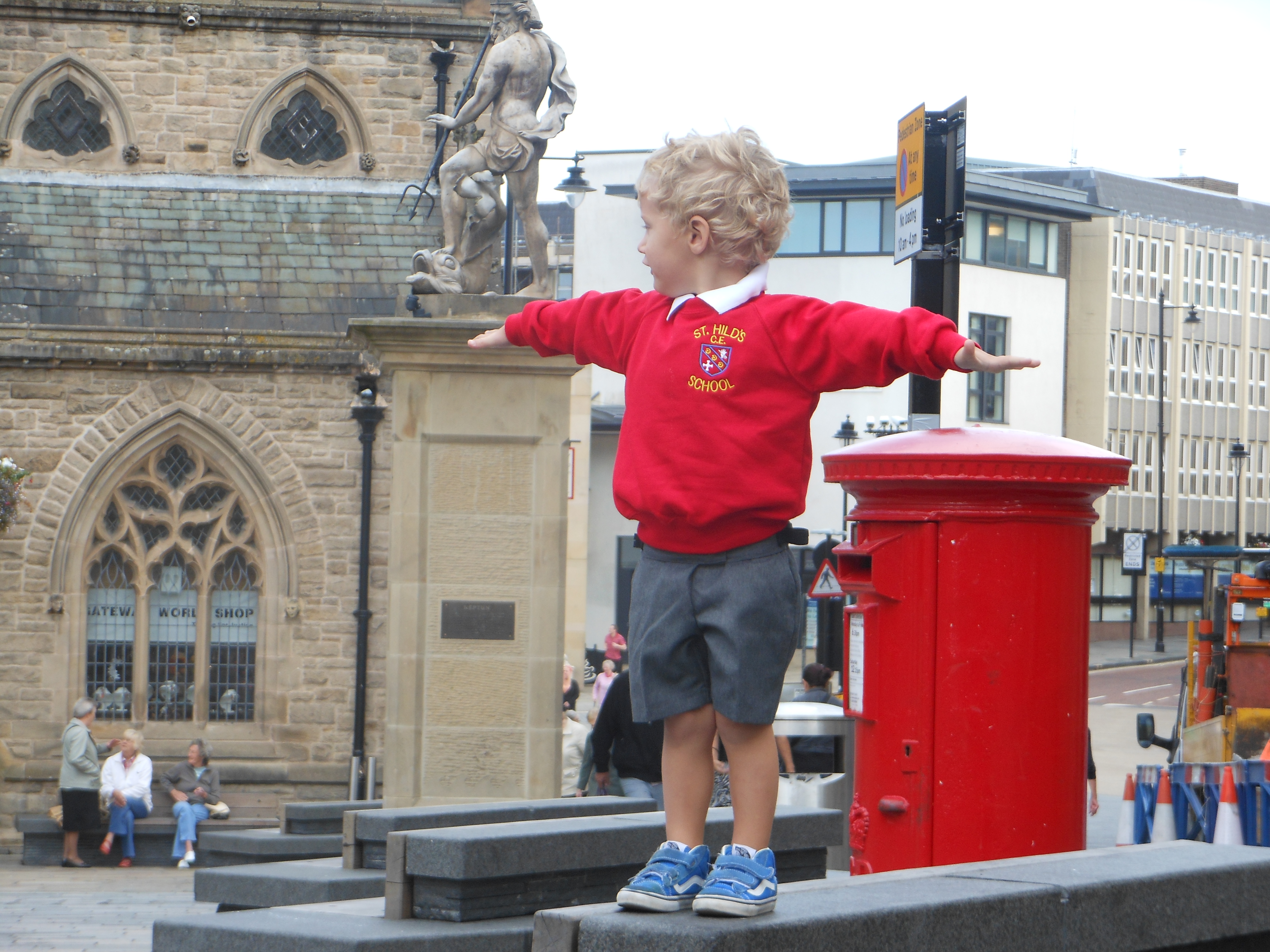
They really take it slowly with the nursery classes here, so George wasn’t actually allowed to stay at school on the first day.  He insisted, however, on wearing his uniform.  I got this cute pic of him in the City Centre, where we went to get our banking figured out.

Image

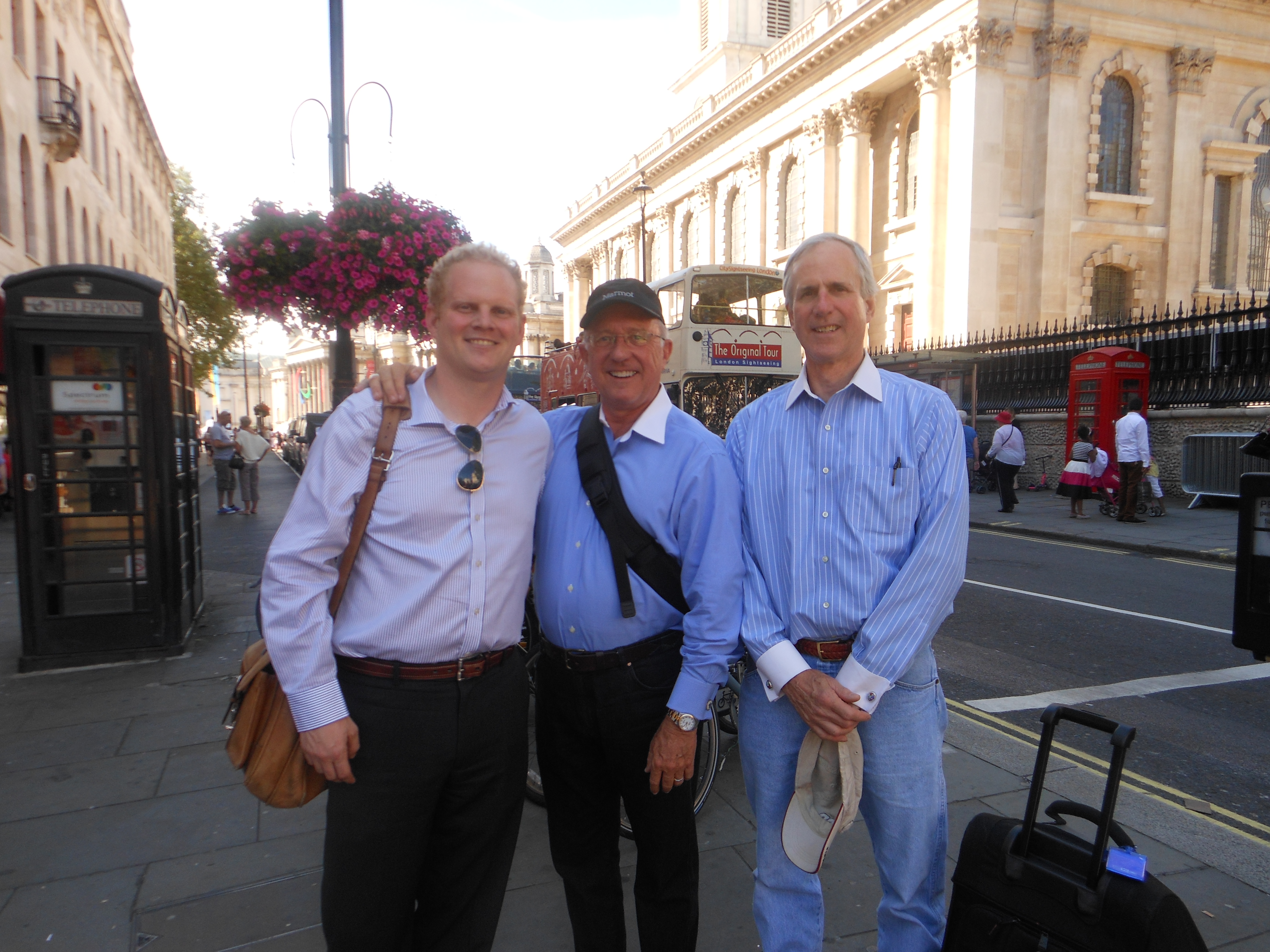
It’s a small world.  I went down to London for the British New Testament Society Conference on our first full weekend in England.  (JE and the boys did very well without me).  On the way back to King’s Cross for the trip home, I met Bob Mark and Terry Fox who were in London on business.  Bob and I, along with Bob’s wife Jane-Ellen, led the new members class at Central Presbyterian Church for the last eight years.  Terry joined Central just last year.

Image

This is what happens when I give Peter our camera and tell him to go take pictures.  This is the posterior of a famous statue in City Centre.  For the last week, at random, Peter says something like, “Hey Charlie, remember the butt picture?  Wasn’t that great?!”

Though I continually feel like I’ve forgotten something essential, I think we’ve sorted the most essential things for now (including starting to use key words like “sort,” “quite,” and “sensible”).  JE didn’t get the job she interviewed for, so she’s regrouping and arranging meetings with recruiters.  We’re hopeful but anxious about that.  I’m eager to get going on work (had my first meeting with my supervisor on Monday, which went well), but, with all of the things we have to do to get established, I haven’t managed to study/work more than 2 hours every other day or so.  That will change soon.  In the meantime, I’m enjoying walking the boys to school each morning.  I’ve been making breakfast for everyone daily too, including JE’s egg cooked hard.  What fun that’s been.

That’s all for now.